How much chlorine do I add?
Enter your pool size and what your test kit says. The answer updates as you type.
Raises free chlorine from 2.5 to 5 ppm, the target for CYA 40.
Pour one chemical at a time in front of a return jet with the pump running. Retest before adding more.
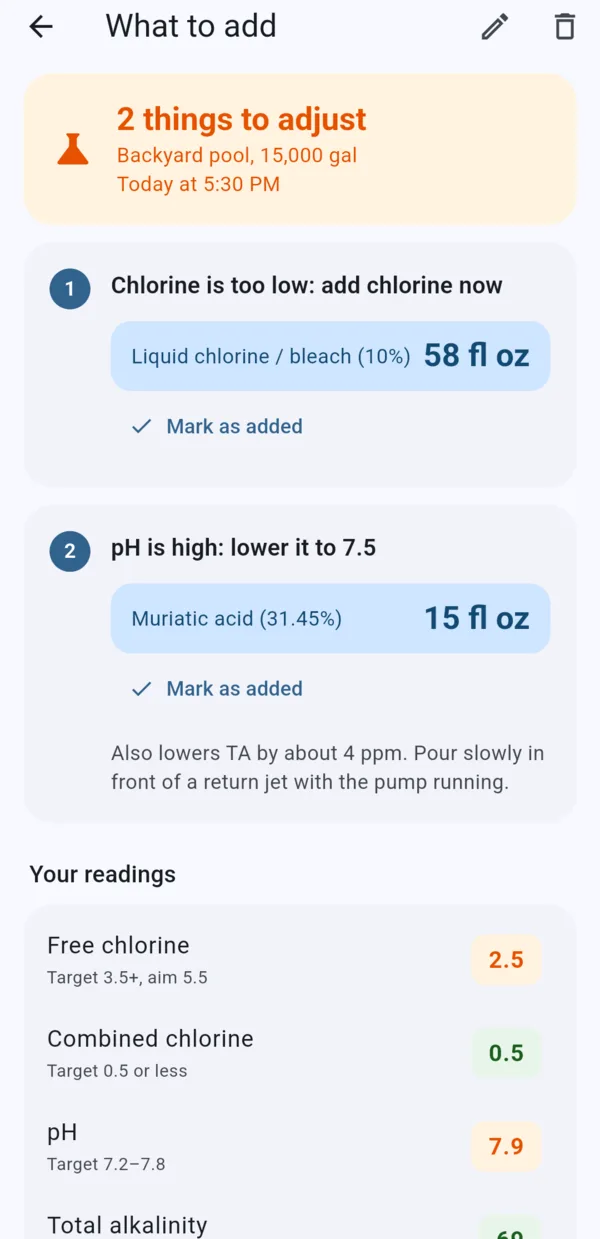
The app does every reading at once
Pool Log for Android takes your whole test, from chlorine to salt, and tells you what to add and in what order. It keeps every test, so you can see where your water is heading.
- Every reading
- Free and combined chlorine, pH, alkalinity, calcium, CYA, and salt.
- In order
- Numbered steps, with side effects: acid lowers alkalinity, cal-hypo adds calcium, dichlor adds CYA.
- Your products
- Liquid chlorine, bleach, cal-hypo, or dichlor at the strength on the label. Muriatic or dry acid.
- History
- Every test, and every chemical you mark as added. Reminders when a test is due. Free.
- Pool volume
- Don't know your gallons? Measure the pool and it works them out, for rectangle, round, oval, and kidney shapes.
- Private
- No account, no ads, no tracking. Works offline, next to the pool.
Free to usePro is $4.99, paid once. It shows how much chlorine your pool uses each day and what your chemicals cost, checks calcium balance to protect plaster, and adds a second pool or hot tub, trend charts, and export.
Coming to Google PlayChlorine targets depend on CYA
Cyanuric acid (CYA, or stabilizer) shields chlorine from sunlight, but it also holds most of that chlorine in reserve. The more CYA in the water, the more free chlorine you need for the same sanitizing power.
That's why "keep it at 1 to 3 ppm" stops working as stabilizer builds up, often from chlorine tablets or dichlor, which add CYA every time you use them. The table shows the targets Pool Log uses. Saltwater pools can run lower because the generator adds chlorine all day.
Shock (SLAM) level is for clearing algae or high combined chlorine: raise free chlorine to that level and hold it until the water clears.
| CYA | Minimum FC | Target FC | Saltwater min. | Shock |
|---|---|---|---|---|
| 0 | 1 | 3 | 1 | 10 |
| 20 | 1.5 | 3.5 | 1 | 10 |
| 30 | 2.5 | 4.5 | 1.5 | 12 |
| 40 | 3 | 5 | 2 | 16 |
| 50 | 4 | 6 | 2.5 | 20 |
| 60 | 4.5 | 6.5 | 3 | 24 |
| 70 | 5.5 | 7.5 | 3.5 | 28 |
| 80 | 6 | 8 | 4 | 32 |
Questions
How accurate is this?
Chlorine, alkalinity, and stabilizer doses are straight arithmetic from your pool size and the product strength. pH doses also depend on your alkalinity and CYA, which the calculator accounts for. Real pools vary, so add a little less than you think, then retest.
What does 10% or 12.5% mean on liquid chlorine?
It's the strength printed on the jug. One gallon of 10% liquid chlorine raises a 10,000-gallon pool by about 10 ppm. Stronger chlorine needs less; weaker bleach needs more.
Should I lower pH or alkalinity first?
If both are high, add acid to bring pH down first. Acid lowers alkalinity too. To lower alkalinity further, drop pH to 7.0–7.2, then aerate with jets or fountains to raise pH without raising alkalinity.
Is there an iPhone version?
Not yet. Pool Log is launching on Android first.